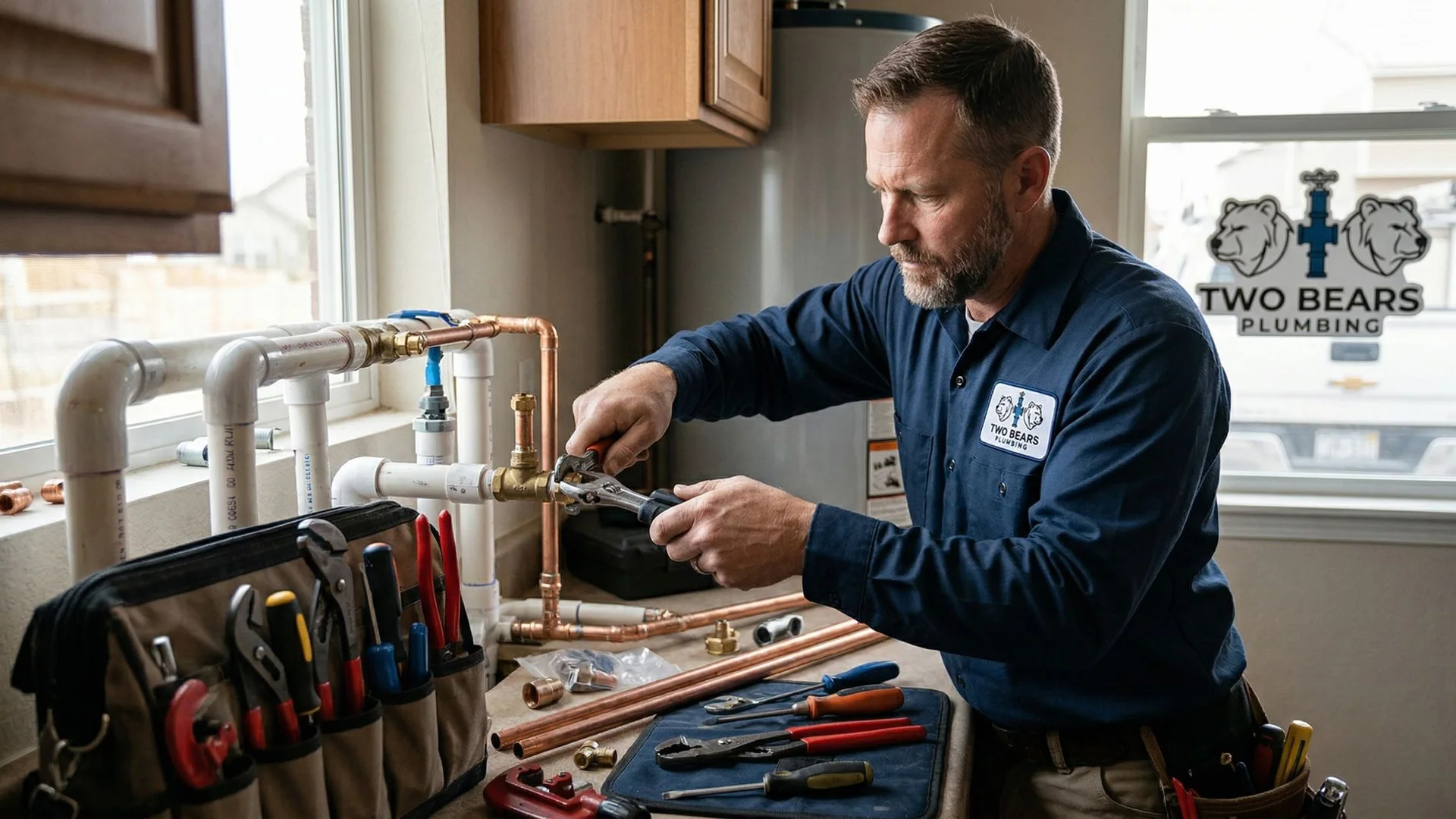
Heating Contractor in Aurora, CO
Water heater repair and installation, plus boiler repair. Tank and tankless, gas and electric, same-day service.
Water heaters in Aurora don't fail the same way they do everywhere else. Aurora's water is hard enough to shorten a water heater's life well below its rated years, and most homeowners don't find out until there's no hot water left.
This page covers our heating services: water heater repair, new water heater installation, and boiler repair. If your water heater or boiler is acting up or already out, call us directly. One licensed team, upfront pricing before any work starts.
Water Heater Repair in Aurora
We repair tank and tankless water heaters, gas and electric, and tell you honestly when a repair makes more sense than a new unit.
Learn More →Water Heater Installation in Aurora
New and replacement water heaters: tank, tankless, and heat pump. We check your water pressure before the new unit goes in.
Learn More →Boiler Repair in Aurora
Boiler repair, replacement, and installation for Aurora homes with hot water heat.
Learn More →What homeowners don't realize is that Aurora's water hardness, roughly 4 to 8 grains per gallon depending on the pressure zone, scales up tankless flow sensors and clogs tank drains years before a water heater would normally fail elsewhere. That's why we bring up descaling on every water heater call, not just new installs.
Regular flushing and descaling extend a water heater's life significantly in hard water areas like Aurora. The EPA's WaterSense program has more on how water heater efficiency and water conservation work together, including why hot water systems are one of the biggest places a home wastes both water and energy.
Heating-Side Plumbing Problems We See by Home Age
Boilers, water heaters, and gas lines sit on the plumbing side of heating. The problems follow the age of the house, so we usually have a good idea what we'll find before we open the panel.
Pre-1965 homes near Colfax. Many of these still run original radiator or baseboard heat off a boiler, and the boiler is often the oldest piece of equipment in the house. We see worn circulator pumps, tired expansion tanks, and nuisance low-water cutoff trips. Our boiler repair page covers those calls.
1970s and 1980s homes. Plenty of these still have original supply lines, shutoff valves, and flexible connectors around the water heater. Fittings from that era weren't built to today's code. Reusing them is how a new tank ends up with a slow leak six months later, so we replace them during the swap.
North Aurora near I-70. Older mains out there commonly run high pressure. High pressure is hard on a new water heater, and it's one of the main reasons a tank starts weeping at the relief valve. We check pressure and the pressure-reducing valve before we set a new unit. Our post on expansion tanks and water heater pressure explains why.
Newer subdivisions. Communities like Southshore, Murphy Creek, and Saddle Rock often have PEX manifold plumbing and compact mechanical closets. The swap itself goes quickly, but a tight closet can limit your choices on tankless and heat pump units.
Cold snaps. The boiler sits indoors, but the piping near it may not. A frozen circulator line or zone valve in an unheated crawlspace or garage can look like no heat even though the boiler is firing fine. Our winterizing guide for Aurora covers the usual weak spots.
What Hard Water Does to Boilers and Water Heaters
Aurora's water is hard. Calcium and magnesium come out of the water when it's heated, and they settle where the heat is. Different equipment shows it in different ways.
- Tank water heaters. Sediment piles up on the bottom of the tank. That layer sits between the burner or element and the water, so the heater works harder for the same hot water. The popping and rumbling you hear is sediment boiling. Anode rods get used up faster too, and a spent rod means the tank starts corroding from the inside.
- Tankless water heaters. Scale builds inside the heat exchanger and clogs flow sensors. We usually see it as flow sensor error codes, reduced flow, or a unit that won't fire.
- Boilers. Scale and sediment wear on the circulator pump impeller, the low-water cutoff, and the heat exchanger. Kettling, that popping or rumbling from the boiler, almost always traces back to sediment.
Most of this is slow and cheap to manage if you catch it early. We recommend flushing a tank water heater once a year at a minimum, and every six months is better in Aurora. A tank that should last 10 to 12 years can end up closer to 6 to 8 without regular flushing. Tankless units need a descale on a schedule. Our guide on how often to flush a water heater has the details.
A small repair like a thermocouple, element, or anode rod is the kind of fix that hard water makes common. Our water heater repair page lists the repairs we do most and their typical ranges.
Gas, Carbon Monoxide, and Relief Valve Safety
Most Aurora water heaters and boilers burn gas. A gas leak, a bad vent, or a failed relief valve is not a repair to try yourself. Here is what to do and what to leave alone.
- You smell gas. Leave the house. Call 911 or your gas utility from outside. Don't flip switches, light anything, or use a phone inside.
- Your carbon monoxide alarm goes off, or you get headaches and nausea when the heat runs. Get everyone outside and call 911. Carbon monoxide has no color, taste, or smell, so the alarm is how you find out. Keep working alarms outside sleeping areas and on every level of the home.
- Water drips or sprays from the temperature and pressure relief valve. Never cap or plug it. That valve is the last safety if pressure or temperature climbs. Dripping means something upstream is wrong, such as high pressure, a dead expansion tank, or a heater running too hot. We find out which.
- Water is pooling under the unit. If you can reach them safely, shut off the cold water supply and the gas or power to the unit, then call us.
- You see soot, scorch marks, or hear banging from a boiler. Stop using it and call.
Don't relight a pilot that keeps going out, bypass a safety control, or open the burner compartment to take a look. A pilot that won't stay lit is usually telling you something is worn, and bypassing a safety control removes the one thing that shuts the appliance down when something goes wrong.
If it's actively leaking or the unit quit in a cold snap, see our emergency plumber page. We offer 24-hour emergency response Monday to Friday.
Repair or Replace, and Why a Licensed Plumber Does the Gas Work
Water heaters. Our rule of thumb is simple. If the unit is under 8 years old and the repair costs less than half of a new heater, we repair it. If it's past 10 years, the tank is leaking from the bottom, or this is your second call this year, replacement is usually the smarter move. A leak from the bottom of the tank is internal corrosion and can't be patched. Most repairs run $150 to $500. A standard tank replacement runs $1,200 to $2,500 installed. Tankless runs $2,000 to $3,800 for electric and $3,000 to $5,500 for gas. We quote a flat rate before we start. Our guides on the signs your water heater is failing and replacement costs in Aurora go deeper, and the tank vs tankless comparison helps if you're switching.
Boilers. A boiler lasts 15 to 20 years on average with regular service. Aurora's hard water can shorten that when the circulator pump or expansion tank goes without attention. One repair on a boiler in its middle years is normal. Repeated circulator or expansion tank failures on the same unit are the clearest sign repair has stopped making sense. If your boiler also heats your domestic hot water, replacement takes more planning, since the new unit has to cover both heating and hot water demand.
Why a licensed plumber should do the gas and venting work. Colorado requires plumbers to be licensed through the Colorado State Plumbing Board, and the state's plumbing law treats fuel gas piping as plumbing work that needs a permit and an inspection. In Aurora, a water heater swap and gas piping work both need a permit, and we pull it and schedule the inspection. That's not paperwork for its own sake. A wrong vent on a gas unit can send carbon monoxide into the house. A loose fitting can leak slowly for weeks. A line that's too small for the appliance starves it.
So we size the gas line to the appliance, pressure test it before anything is connected, match the venting to code, and set combustion for Aurora's altitude per the manufacturer's manual. If you're adding or moving a gas appliance, start with our gas installation service page. Or call (720) 903-1527 and we'll look at it with you.
Need Water Heater or Boiler Service in Aurora?
Same-day service, upfront pricing, licensed professionals.
Call (720) 903-1527